
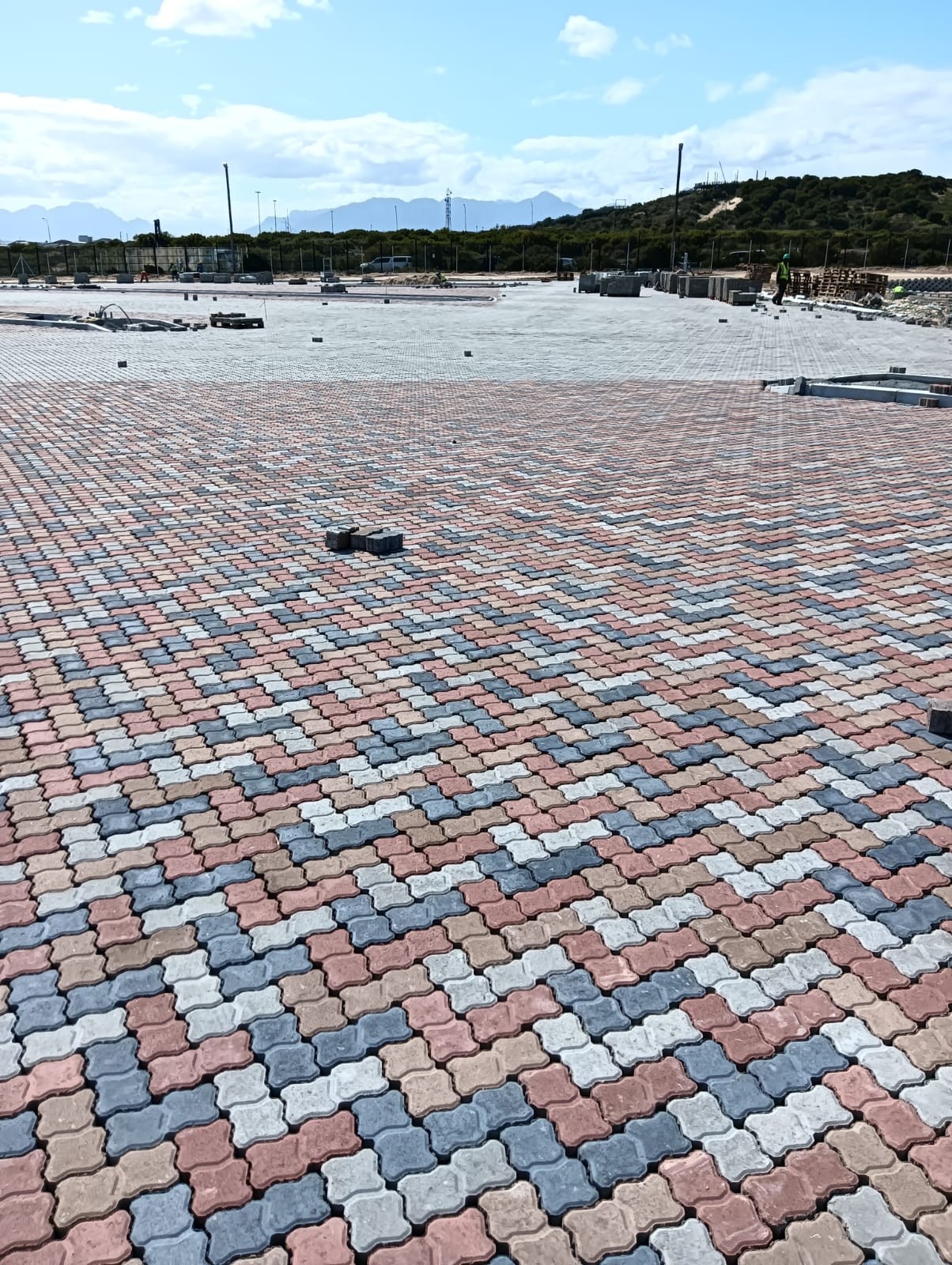
Attractive and functional pavers supplied by C.E.L. Paving Products for the MyCiTi bus depot in Khayelitsha has provided a large-scale example of how
Attractive and functional pavers supplied by C.E.L. Paving Products for the MyCiTi bus depot in Khayelitsha has provided a large-scale example of how concrete block paving can meet the demanding requirements of public transport infrastructure without compromising on appearance or stormwater management.
More than 50 000m² of concrete paving supplied by C.E.L. Paving Products was installed across the facilities incorporating permeable pavers, conventional interlocking blocks, and exposed aggregate finishes. The extensive use of assorted colours and textures creates visual definition across the site, while the paving is designed to withstand the repeated heavy vehicle movements associated with bus operations.
The depots form part of the City of Cape Town’s R474 million Integrated Rapid Transit (IRT) Phase 2A investment in expanding the MyCiTi bus network. Construction began in August 2022, and the facilities were officially opened in October 2025. After a full year of heavy-duty usage, the facilities are still in tip-top condition and after heavier than normal rainfall season, have performed in accordance with the city’s strict stormwater management requirements.
According to C.E.L. Paving Product’s Peter Visser, the facilities will support expanded public transport services linking Mitchells Plain and Khayelitsha, as well as planned connections to Claremont and Wynberg.
“The project required us to supply more than 27 000m² of grey Permealock permeable pavers, together with approximately 19 000m² in various colours. A further 9 000m² of conventional interlocking pavers and 3 900m² of coarse exposed aggregate pavers in Brownstone was also required to complete the installation”
“The combination of colours was chosen for both practical and aesthetic reasons. While the large grey paved areas provide a consistent finish the coloured sections help distinguish passenger loading and access areas. The varied pattern also has the practical benefit of making tyre marks, dirt, and oil stains less conspicuous across heavily used surfaces,” says Visser.
He explains that one of the project’s defining features is the extensive use of permeable paving to manage stormwater. Cape Town’s requirements for new developments place an emphasis on managing runoff at source, using solutions such as permeable surfaces, swales, and retention facilities. The Permealock paving system allows rainwater to pass through openings between the pavers into a specially designed pavement structure. Twelve protruding lugs on the vertical faces of each block create the spaces required for water infiltration while helping to resist lateral movement.
The Permealock paver has a water-throughput capacity of 13 000 litres/m2, per hour and in combination with the carefully constructed underlayers works in conjunction with underlying aggregate layers and geotextile, allowing water to infiltrate into the pavement structure. Subsurface drainage channels direct excess water towards retention ponds when the underlying layers reach their storage capacity.
Visser adds that the system is particularly relevant to large developments like this one where extensive hard surfaces would usually generate substantial stormwater runoff. By incorporating drainage into the paved surface itself the project meets the City of Cape Town’s Sustainable Urban Drainage Systems (SUDS) requirements for urban water-management.
The paving specification also had to accommodate the forces generated by heavy buses particularly when turning. Unlike vehicles travelling in straight-line buses exert significant lateral forces on the pavement as their tyres drag across the surface during manoeuvres.
He explains that the 16-sided profile of the interlocking pavers provides more contact faces between adjacent blocks than a conventional rectangular paver. This increases resistance to movement under the sideways forces generated by turning wheels. In addition, they had to meet strict strength requirements considering the weight of the buses and high traffic volumes and were subsequently tested to meet specified compressive strengths exceeding 45 MPa. Peter reported that tensile test results also exceeded 3 MPa. Production batches were tested regularly throughout the project to maintain consistent quality across the different colours and product types.
The supporting pavement structure was equally important. Much of the Cape Town region has fine sandy soils, making the stabilisation and preparation of the underlying layers critical to long-term performance. Site testing including sonic and dynamic probing investigations was conducted during construction to verify the condition of the supporting layers as “the performance of concrete block paving depends on the quality of the pavement structure beneath it as much as on the blocks themselves.”
C.E.L. Paving Products manufacture both standard and topped pavers for increased abrasion resistance. The wearing layer in the concrete block paving incorporates silica sand which provides better bonding characteristics with cement than the fine local sand used in the Cape.
Visser adds that the company operates three manufacturing facilities with dedicated production for exposed aggregate, domestic paving, and industrial products. C.E.L. Paving’s’ industrial production line incorporates an upgraded German vibration system designed to achieve high compaction and low water absorption with an in-house laboratory that conducts regular testing across its manufacturing operations.
Successful showcase projects like the MyCiTi bus depot in Khayelitsha has earned C.E.L. Paving Products considerable bragging rights and as a result of this and other successful, attractive, and functional projects, C.E.L. Paving continues to supply substantial quantities of permeable paving and other high quality blocks, across the region. The BRT development in Khayalitsha also shows the way forward for transport facilities and other developments with large, paved surfaces.
