
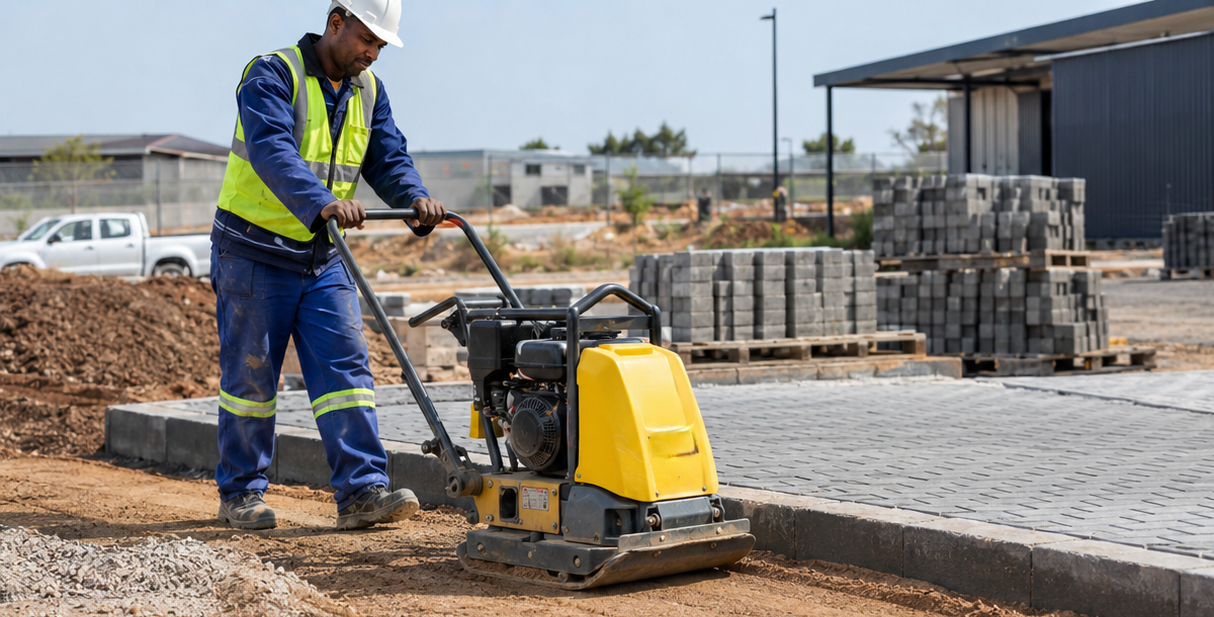
A plate compactor is a relatively simple machine but choosing one purely on price or engine size can result in problems down the road, with slower wor
A plate compactor is a relatively simple machine but choosing one purely on price or engine size can result in problems down the road, with slower work, inadequate compaction or in the case of concrete paving can even damage blocks.
For anyone preparing a larger paved area the starting point should be the material being compacted rather than the machine itself. Sand, gravel, crushed stone and soil containing a mixture of materials respond differently to vibration while cohesive clay-type soils can require a different machine altogether.
The basic purpose of compaction is to remove air from the material and bring the particles closer together. The amount of force required depends on the material, the thickness of the layer and its moisture content. A heavier machine is not automatically better because excessive force on a thin layer can disturb rather than improve the surface.
Most paving failures are associated with what happens below the blocks rather than with the blocks themselves. A paved driveway normally consists of the prepared natural ground, a compacted sub-base, a bedding layer and the paving units. Each layer needs to be treated according to its characteristics.
Granular materials such as sand, gravel, crushed stone and the aggregate mixtures commonly used in paving construction respond particularly well to vibratory plates. Vibration causes the particles to rearrange and settle into a denser structure. This is the territory in which a conventional forward-moving plate compactor is particularly useful.
For a small residential path or patio where the material is relatively thin and access is restricted, a light machine can be more practical. A 50- to 70-kg machine is considerably easier to move around a garden and can get into areas where a 100-kg or heavier plate becomes cumbersome. Compact machines commonly range from the 53 kg with a 320 mm working width to the 110 kg with a 500 mm plate. The manufacturers specify these machines for earthworks, asphalt and paving, with the smaller machines particularly suited to small-scale work and restricted areas.
For a typical residential driveway the middle of the range is often more practical. A machine weighing around 80 to 110 kg, with a plate around 400 to 500 mm wide and centrifugal force in the region of 15 to 20 kN, provides a useful combination of manoeuvrability and productivity. The important point is that centrifugal force should not be considered in isolation. The operating weight, plate dimensions, vibration characteristics, travel speed and the material being compacted all affect the result.
Once the job involves thicker layers of crushed stone, larger driveways, road shoulders, extensive paving or repeated reinstatement work, a reversible plate becomes more attractive. Unlike a conventional forward plate, a reversible machine can travel forwards and backwards. This means the operator does not have to lift or turn the machine at the end of every run, and the machine can be manoeuvred more effectively in confined areas.
Reversible plates are also generally heavier and deliver substantially more centrifugal force. That does not mean a 40 or 60 kN machine should automatically be selected for domestic paving. A large reversible plate can be unnecessarily difficult to transport and manoeuvre on a small property. The machine needs to match the thickness and type of material being compacted.
There is also a point at which a plate compactor is no longer the appropriate machine. Cohesive soils containing significant amounts of clay do not respond in the same way as clean granular material. A vibrating plate may compact the surface without achieving the required result deeper down. For narrow trenches, pipe bedding and cohesive backfill, a tamping rammer is often more appropriate because its vertical impact is concentrated over a much smaller area. Rental companies similarly distinguish between plate compactors for broader ground preparation and rammers for trenches and confined areas.
Moisture is another important consideration. Soil that is excessively wet can become difficult to compact and may deform under the machine rather than becoming denser. Conversely, material that is excessively dry may not compact as efficiently. The correct moisture condition depends on the material, which is why professional earthworks are normally based on specified compaction requirements rather than simply running a machine over the surface a certain number of times.
Plate size becomes increasingly important as the paved area gets larger. A narrow plate is easier to manoeuvre around walls, kerbs, posts and garden features, but covers less ground with each pass. A wider plate covers more area, reducing the number of passes needed, but requires more room to turn and is generally attached to a heavier machine.
Paving blocks need a different approach
Compacting the material underneath the paving is different from compacting the finished paving itself. Once interlocking concrete paving has been laid, the objective is to settle the blocks into the bedding material and help establish the finished surface without damaging or marking the units. This is where a suitable polyurethane or rubber mat becomes important, particularly with decorative or coated paving.
Some manufacturers specifically offer polyurethane mats for plate compactors for use on concrete paving stones, including coated surfaces. These reduce marking and the risk of breaking paving units during compaction. The machine therefore needs to be selected with the entire job in mind. The same plate that is useful for compacting a crushed-stone sub-base may need a paving mat before it is used on the finished blocks.
For a homeowner or contractor doing occasional paving, hiring is usually worth considering before buying. Current South African hire prices illustrate the relatively low entry cost from as little as R354 per day. Hiring also means that the user can select a different machine for different jobs. A small forward plate may be all that is required for a garden path, while a heavier reversible machine may be justified for a large driveway or substantial sub-base.
Buying becomes more attractive when the machine is going to be used regularly. A paving contractor, landscaper, maintenance contractor or small civil contractor can spread the capital cost over many jobs and avoid repeated collection and delivery charges. Ownership also means the operator knows the history of the machine and can select the machine configuration, such as a paving mat or water tank, to suit the work.
Right for the job
For the average person laying paving, the most useful way to select a plate compactor is to work backwards from the job. A small garden path on granular material does not justify a 300 kg reversible machine. A large driveway with a substantial crushed-stone base may justify a wider and heavier reversible plate because productivity and compaction depth become more important. Clay-rich or confined areas may call for a rammer instead of a plate, while finished concrete paving requires attention to the base mat and machine setting.
The cheapest machine is therefore not necessarily the cheapest way to complete the job. Nor is the biggest machine automatically the most effective. The right combination of machine weight, centrifugal force, plate width, travel direction and surface protection should follow the material being compacted and the size and layout of the area.
For occasional paving, hiring provides a relatively inexpensive way of obtaining the appropriate machine for each stage of the work. For contractors using compactors repeatedly, purchasing a recognised machine with accessible parts and local technical support becomes a longer-term equipment decision rather than simply a question of the initial price.
