
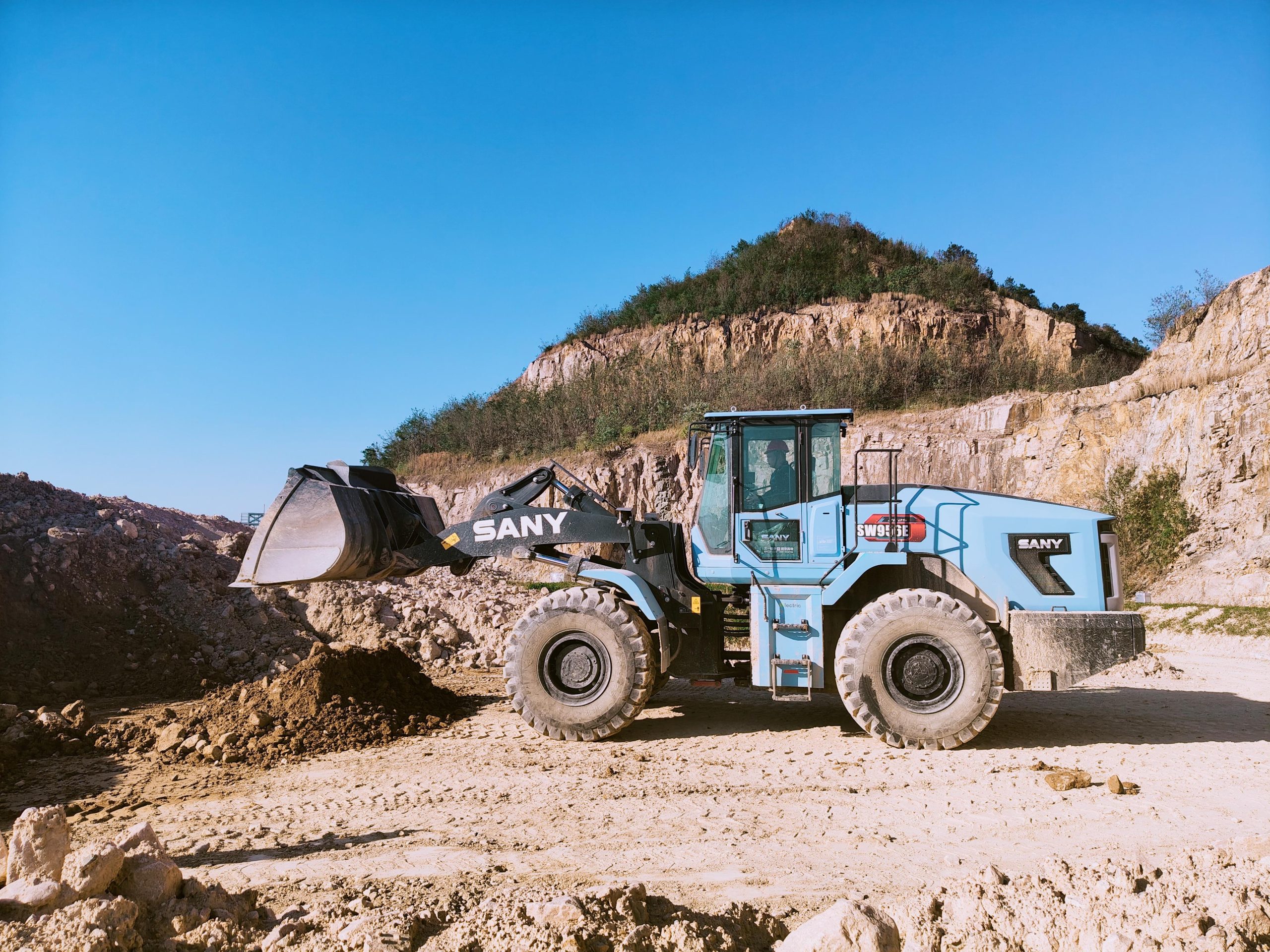
The South African concrete industry has become increasingly exposed to global energy shocks with the latest escalation of conflict in the Middle East
The South African concrete industry has become increasingly exposed to global energy shocks with the latest escalation of conflict in the Middle East again highlighted the vulnerability of operations that rely heavily on diesel-powered equipment.
Although diesel prices softened slightly during June 2026 equipment users are still paying in excess of R30/litre for fuel. In the yards of concrete producers and readymix operations the trusty wheel loader is among the most widely used pieces of equipment and they run continuously feeding batching plants, loading aggregate stockpiles, handling raw materials and supporting logistics operations.
This has placed electric wheel loaders firmly on the radar of South African concrete producers seeking greater control over operating expenses.
According to Freg Wei, deputy general manager of Sany in Southern Africa, it is easy to see why the market is calling for electric equipment and is the reason Sany is introducing a new range of electric loaders. He says the maths is easy to work out with a conventional 5-ton wheel loader consume approximately 14 to 18 litres of diesel per hour depending on application and loading cycles. At current diesel prices, fuel for loading alone can represent one of the largest variable costs on a concrete production site and can easily amount to well over R5000 per shift for fuel alone.
Using SANY’s comparative operating data, a traditional diesel loader consuming around 16 litres per hour incurs higher energy costs than an equivalent electric machine. Over a typical 3,000-hour operating year the difference becomes significant enough to influence equipment procurement decisions rather than simply day-to-day operating budgets. For many producers, the question is no longer whether electric equipment can work but whether they can continue absorbing volatile diesel costs.
SANY’s latest generation of electric wheel loaders has been developed specifically for heavy-duty industrial applications including construction, quarrying, concrete production and bulk material handling.
The range includes:
• SW936E – 3.5-ton capacity
• SW956E – 5.8-ton capacity
• SW970E – 7.0-ton capacity
• SW978E – 7.5-ton capacity
According to Wei the machines are tried and tested with more than 3,000 units having already accumulated over 10 million operating hours since introduction. Available data already points to significant benefits of replacing diesel machines and allays one of the biggest concerns among plant managers considering electrification whether electric machines can match the productivity of conventional loaders.
SANY globally says its electric loaders were designed around the same hydraulic and steering architecture used in conventional diesel machines. It also reports industry-leading performance in three critical loader metrics including traction force, gradeability and lifting force. The performance advantages also equate to productivity gains where the machines’ two forward speed ranges allow operators to select either high-speed travel or precision loading modes, while full hydraulic braking provides familiar machine control characteristics. The machines also use proprietary machine-control systems and active energy recovery technology designed to maximise efficiency during operation. For concrete plants where loading cycles are repetitive and predictable, these characteristics make electrification particularly practical.
Wei says the strongest argument for electric wheel loaders remains operating cost. Using SANY’s operational data for its 5-ton machine electricity consumption averages approximately 35kWh per operating hour compared with diesel consumption of around 16 litres per hour for an equivalent conventional machine.
The resulting energy cost differential creates a substantial saving over the machine’s lifespan and the company calculates that energy costs can be reduced by approximately 75% compared with conventional diesel-powered loaders under comparable operating conditions.
Over 3,000 annual operating hours, these savings can translate into hundreds of thousands of Rands in reduced operating expenditure depending on local electricity tariffs and diesel pricing. For concrete producers operating multiple loaders the cumulative impact can be considerable.
Reduced Maintenance
Maintenance represents another significant operating expense often overlooked when evaluating equipment costs. Electric wheel loaders eliminate many of the routine service requirements associated with diesel engines.
There are no:
• Engine oil changes
• Fuel filters
• Air filters
• Engine-related consumables
• Exhaust after-treatment systems
According to Wei the electric system is maintenance-low and reduces servicing costs and planned downtime. For around the clock operations fewer maintenance interventions can translate directly into improved machine availability. As far as batteries are concerned operating runtimes of between eight and ten hours per charge can be expected covering a typical production shift in many concrete applications.
Charging performance is also designed around industrial operating requirements:
• 20% to 80% charge in approximately 48 minutes
• 20% to 100% charge in approximately 90 minutes
This allows charging during shift changes, lunch breaks or planned production downtime. For sites requiring continuous operation, charging infrastructure can be integrated into fleet management strategies.
“Many contractors assume diesel infrastructure is cheaper than charging infrastructure but comparative analysis suggests otherwise. Establishing a dedicated diesel storage facility can represent a substantial capital investment once tanks, bunding, environmental compliance requirements and safety systems are considered.
“By comparison, charging infrastructure can be implemented at a lower initial cost, particularly where existing electrical capacity is available. For permanent concrete production facilities, the economics become increasingly favourable over time.
“Renewable energy can also be investigated in many instances where electric wheel loaders can be integrated into microgrid systems incorporating solar or wind energy. For concrete producers with large roof areas, unused land or quarry properties, renewable energy generation could offset a significant portion of charging costs,” says Wei.
He adds that as fuel prices continue their upward trajectory and environmental regulations become more stringent globally, electric equipment is expected to retain increasing value through lower operating costs and growing market acceptance. The recent diesel price shock has exposed a risk that many concrete producers have been reluctant to confront that means energy costs have become a strategic business consideration.
“For operations that rely heavily on wheel loaders our electric alternatives offer a realistic pathway to gaining a competitive advantage and avoiding future fuel price shocks,” concludes Wei.
