
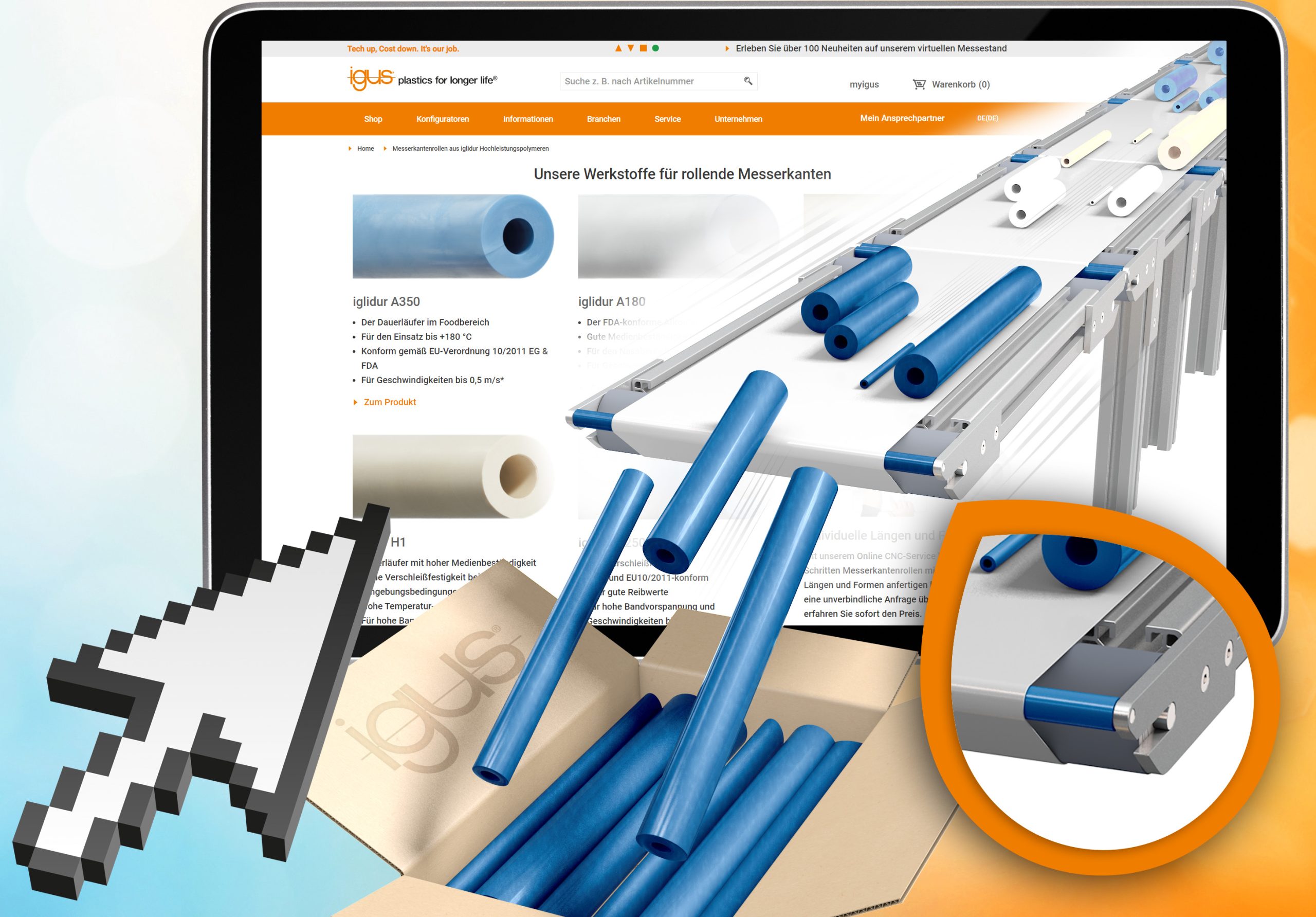
Polymer component specialist manufacturer igus has developed a range of lubrication-free long-life knife edge rollers designed to improve the transfer
Polymer component specialist manufacturer igus has developed a range of lubrication-free long-life knife edge rollers designed to improve the transfer of products between conveyor belts in high-speed production environments such as cement packaging and concrete brick and block plants.
The company’s knife edge rollers are specialised guide rollers used at the transfer between conveyor belts. They allow conveyor belts to wrap around very small radius so that products can transfer smoothly from one belt to another with the smallest possible gap. This prevents snags and stops smaller items from dropping between conveyors.
Knife edge rollers are commonly used in automated production lines where seamless and efficient product transfer is required for typical applications that include the transfer of brick, blocks, tiles, cement bags and other fast-moving items among others.
According to igus product specialist, Juan-Eric Davidtz, igus uses its world-renowned tribologically optimised polymer materials for the rollers and these deliver low-friction, lubrication-free operation while enabling extremely tight belt deflection. “Machine builders and conveyor system designers rely on our knife edge rollers to maintain consistent product flow while keeping conveyor layouts compact. The smaller the belt deflection radius, the smoother the transfer between conveyors which improves production efficiency and reduces product losses.
“This is what sets igus knife edge rollers apart as our iglidur materials are engineered specifically for industrial motion applications and contain embedded solid lubricants. As a result, the rollers operate completely dry with no need for grease or oil lubrication,” he says.
Juan-Eric adds that the lubrication-free design prevents contamination while reducing maintenance requirement and improving longevity of the rollers exponentially which is critical in abrasive cement and concrete plants. This means the rollers can operate reliably for extended periods and can be used in “dirty” or dusty environments.
The igus knife edge rollers are also tougher than steel alternatives. They offer higher wear and corrosion resistance as well as lower friction which allows them to operate smoothly in continuous-duty conveyor systems. Their polymer construction also provides good chemical resistance and corrosion protection in chemical processes while the lightweight design can reduce drive loads compared with conventional metal rollers.
“We continuously communicate with equipment manufacturers who are keen to exploit these advantages in a wide range of applications. With a broad selection of standard sizes as well as customised configurations it enables OEMs and machine builders to match roller geometry and dimensions precisely to their conveyor systems. This is important in high-speed production environments where even small interruptions can lead to downtime and where the reduction downtime equates to improved profitability,” Juan-Eric concludes.
