
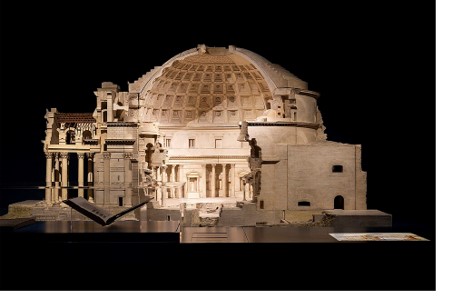
The most fascinating part of the Pantheon in Rome is its giant dome, with its famous hole in the top (The eye of the Pantheon, or oculus). The dome wa
The most fascinating part of the Pantheon in Rome is its giant dome, with its famous hole in the top (The eye of the Pantheon, or oculus). The dome was the largest in the world for 1300 years and to present remains the largest unsupported dome in the world.
The Pantheon dome stands as a towering testament to the genius of Ancient Roman architecture, a staggering achievement for a structure completed around 126 AD during the reign of Emperor Hadrian.
The dome of the Pantheon in Rome is a perfect hemisphere. Its diameter is a remarkable 43.3 meters, which is exactly equal to the interior height of the rotunda from the floor to the oculus. This geometric precision creates a visually stunning and harmonious interior space. The dome’s weight is a massive 4,500 metric tons, yet it has stood firm for nearly two millennia.
Roman concrete is particularly strong because it makes use of volcanic ash as one of the ingredients. The chemical reaction from using this material actually makes the concrete stronger over time. The design has also allowed the dome to stand for as long as it has. The dome is a perfect half sphere. The diameter across is as long as the dome is tall from floor to oculus.
The Architectural Design of the Pantheon Ceiling
The most distinctive feature of the pantheon ceiling is the oculus—a circular opening at the very top. Measuring 8.2 meters in diameter, the oculus serves as the only source of natural light, essentially functioning as a giant skylight. It was deliberately left open to the sky, allowing rain to fall into the building, which is then drained by a system of 22 holes in the floor.
Below the oculus, the interior surface of the dome is adorned with five rings of 28 deeply recessed panels, known as coffers. These coffers served a dual purpose: they dramatically reduced the overall weight of the structure while also providing an aesthetic, patterned effect that draws the eye upward to the oculus.
How the Dome of the Pantheon was Constructed?
The secret to the dome’s longevity lies in the sophisticated use of Roman concrete (opus caementicium). Roman engineers cleverly varied the concrete mix as they built upward. They used heavier, denser aggregates (like travertine) at the base and progressively lighter materials (like porous volcanic scoria and tufa) toward the top near the oculus.
Furthermore, the dome’s thickness was significantly tapered—it is a robust 5.9 meters) thick at the base but thins out to just 1.5 meters around the oculus. This strategic use of lightweight materials and graduated thickness was crucial in managing the downward and outward thrust, ensuring the stability of the immense pantheon dome.
The engineering behind the Pantheon dome represents a pinnacle of Roman ingenuity. They utilized a massive, complex wooden framework to support the dome during construction, a feat of temporary scaffolding that was nearly as impressive as the final structure. The construction also showcases an early understanding of arch and vault principles, as the weight is channelled down through 8 massive piers hidden within the walls of the rotunda.
Light and Space: The Role of the Dome in the Pantheon
The dome and its oculus fundamentally define the interior experience of the Pantheon. As the sun moves across the sky, the beam of light entering through the oculus acts like a giant spotlight, sweeping across the coffered ceiling and walls. This dramatic, ever-shifting quality of light creates a dynamic, spiritual atmosphere. The architect’s goal was to connect the human space with the divine heavens, an effect achieved entirely through light, scale and perfect geometry.
The dome of the Pantheon remains an indispensable reference point in the history of architecture, influencing Renaissance masters like Brunelleschi (for the Florence Cathedral dome) and Michelangelo (for St. Peter’s Basilica) and continuing to inspire modern designers.
The 4,535-tonne weight of the Roman concrete dome is concentrated on a ring of voussoirs 9.1 metres in diameter that form the oculus, while the downward thrust of the dome is carried by eight barrel vaults in the 6.4-metre-thick drum wall into eight piers. The materials used in the concrete of the dome also vary. At its thickest point, the aggregate is travertine, then terracotta tiles, then at the very top, tufa and pumice, both porous light stones. At the very top, where the dome would be at its weakest and vulnerable to collapse, the oculus lightens the load.
Beam in the dome of the Pantheon
No tensile test results are available on the concrete used in the Pantheon; however, tests on ancient concrete from Roman ruins in Libya, which gave a compressive strength of 20 MPa. An empirical relationship gives a tensile strength of 1.47 MPa for this specimen. Finite element analysis of the structure found a maximum tensile stress of only 0.128 MPa at the point where the dome joins the raised outer wall.
The stresses in the dome were found to be substantially reduced by the use of successively less dense aggregate stones, such as small pots or pieces of pumice, in higher layers of the dome. It is estimated that, if normal weight concrete had been used throughout, the stresses in the arch would have been some 80% greater. Hidden chambers engineered within the rotunda form a sophisticated structural system. This reduced the weight of the roof, as did the oculus eliminating the apex.
The height to the oculus and the diameter of the interior circle are the same, 43.3 metres, so the whole interior would fit exactly within a cube (or a 43.3-m sphere could fit within the interior). These dimensions make more sense when expressed in ancient Roman units of measurement: The dome spans 150 Roman feet; the oculus is 30 Roman feet in diameter; the doorway is 40 Roman feet high. The Pantheon still holds the record for the world’s largest unreinforced concrete dome. It is also substantially larger than earlier domes. It is the only masonry dome to not require reinforcement. All other extant ancient domes were either designed with tie-rods, chains and banding or have been retrofitted with such devices to prevent collapse.
The Romans’ mastery of concrete allowed them to create a massive, unreinforced dome that has withstood the test of time. This achievement demonstrated the potential of concrete as a building material and inspired future architects to explore its possibilities.
The oculus Pantheon Rome also inspired future architects. The concept of a central opening at the top of a dome was adopted by many Renaissance and Baroque architects, who used it to create dramatic lighting effects and emphasize the spiritual significance of their buildings.
